
There is something profoundly short-sighted about closing language departments, reducing opportunities to study languages, or making it harder for students to spend a year abroad. When we remove languages from education, we do not just remove a subject from a timetable; we remove a world of possibilities that may not yet have revealed themselves.
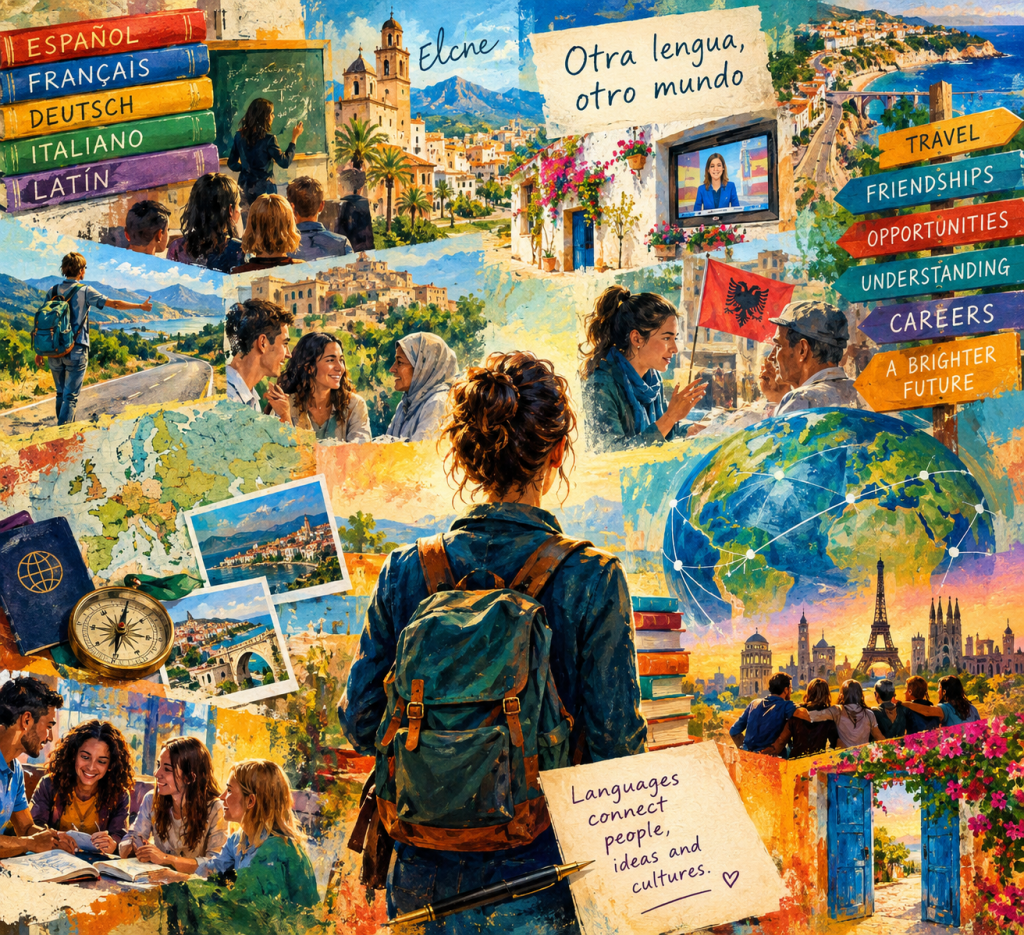
I know that because so much of my own life has been shaped by opportunities to learn and use other languages. Looking back, I can trace an extraordinary number of the experiences, friendships, adventures and career opportunities I have had to decisions made decades ago about what I was allowed to learn in a classroom. At school, I studied Spanish, French, German, Italian and Latin. At the time, I had no idea where those languages would eventually take me, but they gave me a foundation for a life that would become far more international than I could ever have anticipated.
Spanish and Portuguese eventually took me to university and then to Elche in Spain for a year abroad. I lived in a flat with a French student and a German student, taught English at a local Escuela Oficial de Idiomas and privately, and gradually discovered another language alongside the language I had gone there to study. I learned Valencian and became sufficiently familiar with it to watch (questionable) quiz shows on Canal Nou (the regional TV channel) and have conversations with local people. More importantly, I discovered what it meant to live somewhere rather than just visit it. I was immersed in another culture, surrounded by people from different countries and constantly challenged to see familiar things from unfamiliar perspectives.
That experience stayed with me long after I returned home. Portuguese took me hitchhiking through northern Portugal, while other languages carried me into homes, workplaces and conversations across Europe. Places that had once existed only on maps became places I knew personally, and people who would otherwise have been strangers became friends, colleagues and part of my story. Eventually, languages became my career, leading me into work as a translator, teacher and interpreter.
Some of my most significant professional experiences have involved Albanian. I have worked in Kosovo and Albania, where the language was not merely something I had studied or something that appeared on a page. It was a means of connecting with people, understanding perspectives, navigating unfamiliar situations and being trusted with their words and stories. Those experiences reinforced something I had already begun to understand: a language is never just a communication system. It is a way of gaining access to people and experiences that would otherwise remain beyond our reach.
Those are several reasons why I find the gradual erosion of opportunities to study languages so troubling. When a school closes a language department, when a university withdraws a language course, or when fewer students are given the opportunity to spend meaningful time abroad, the immediate decision may be presented as a matter of budgets, timetables or institutional priorities. But the consequences are much larger than those calculations suggest. We are deciding how many opportunities the next generation will have to encounter people, ideas and cultures beyond their immediate experience.
There is also a damaging tendency to think of languages as subjects that belong to a particular type of student: perhaps those who are already academically inclined, naturally interested in other cultures or destined for a career in translation or diplomacy. My own experience tells me how misleading that assumption is. Languages can lead into almost any field, and they can complement rather than compete with other areas of education. They can sit alongside science, mathematics, technology, business, law, journalism, medicine, engineering, art and countless other disciplines because all of those fields ultimately involve people communicating, collaborating and understanding one another.
Nor should we imagine that technology makes human language skills less important. Technology can translate words with remarkable speed, but communication is about far more than transferring words from one language to another. It involves context, humour, trust, cultural understanding and the ability to recognise what someone means as well as what they have said. The more interconnected our world becomes, the more important it is that we have people who can navigate those complexities rather than simply pass information between languages.
The same applies to spending time abroad. For me, my year in Elche was transformative precisely because it involved much more than studying in another country. I learned through getting lost, making mistakes, teaching, travelling, listening, adapting and simply dealing with the ordinary business of everyday life somewhere unfamiliar. I learned how to navigate a different environment and became more confident about dealing with situations where I could not rely on everything being familiar.
That kind of experience is difficult to reproduce inside a classroom. A holiday can introduce you to another country, but an extended period abroad allows you to experience its rhythms and routines. You encounter the supermarket, the bus timetable, the local café, the bureaucracy, the television programmes and the little cultural habits that a visitor might never notice. You stop being merely an observer and start becoming part of the environment around you. You return home with more than memories: you return with a broader sense of what is possible.
That opportunity should not become a privilege available only to those who can afford it. Nor should access to language learning increasingly depend upon where a young person happens to go to school or university. If we believe education should broaden horizons and expand opportunity, then languages and international experiences should be protected rather than progressively squeezed.
There is a particular irony in reducing language provision at a time when young people are growing up in a world in which international communication is increasingly normal. Businesses operate across borders, scientific research is collaborative, technology connects people instantaneously, and workplaces are often culturally and linguistically diverse. We rightly encourage young people to develop digital skills and understand the wider world. Languages belong firmly within that vision of the future.
But there is something even more fundamental at stake. Languages teach us that our own way of seeing the world is not the only possible one. They force us to listen carefully, to reconsider assumptions and to recognise that ideas which seem obvious in one culture may look very different in another. In an age when it is remarkably easy to retreat into familiar bubbles, that capacity for curiosity and perspective is not an educational luxury. It is an essential human skill.
This is why I believe we need to change the way we talk about languages. They should not be regarded as expendable extras that can be removed whenever educational provision becomes difficult to sustain. Nor should their value be judged solely by the number of students who eventually use them professionally. We do not ask every student who studies history whether they will become historians, or every student who studies music whether they will become professional musicians. Education gives us opportunities to discover interests and abilities whose eventual value cannot always be predicted. The same principle should apply to languages.
Some students will build careers around them. Others will use them alongside another profession. Some will spend a year abroad and return with lifelong friendships. Others may simply use their language to have a conversation with someone they would otherwise never have met. We cannot know in advance which experiences will prove transformative, and that is precisely why we should preserve the opportunity to have them.
When I think about my own education, I cannot separate the languages I learned from the places I have been, the people I have met, the work I have done or the stories I have collected along the way. Without those opportunities, my life would have been immeasurably narrower. I would have missed people I am immensely glad to have known, places that became important to me and experiences that changed the way I understand the world.
There is a young person sitting in a classroom today who may be at the beginning of a similarly unexpected journey. They may not yet know that the language they are learning could eventually take them abroad, shape their career, introduce them to lifelong friends or give them access to a culture that will become an important part of their life. They may just know that they enjoy the lesson. That is enough.
We should not be the generation that closes the door before they have had the chance to discover what lies beyond it.
Schools and universities are not merely deciding which subjects they can afford to offer. They are helping to determine the range of futures their students can imagine and pursue. A language department is therefore about much more than courses and classrooms. It is a place where possibilities begin, where curiosity can develop into confidence, and where a subject learned at eleven or sixteen can eventually lead somewhere nobody could have predicted.
We need to protect those possibilities. We need to make language learning accessible to as many young people as possible, sustain the departments and courses that make that learning possible, and ensure that spending meaningful time abroad remains an achievable part of education rather than an increasingly inaccessible privilege.
Because once a language department disappears, bringing it back is not just a matter of restoring a line to a timetable. An opportunity has already been lost, and there is no way of knowing whose future might have depended upon it.
My own life is a reminder of what can happen when we choose to keep those opportunities open. The languages I learned at school eventually led me to university, to Elche, to Portugal, to Kosovo and Albania, and into a career I could never have mapped out when I first encountered those languages in a classroom. The journey was anything but predictable, and that is precisely what made it so extraordinary. We should give the next generation the same chance to surprise us.
So let’s not measure languages only by enrolment figures, budgets or immediate economic returns. Let’s measure them by the possibilities they create: the perspectives broadened, the connections made, the confidence gained, the careers unlocked and the lives changed in ways that cannot be predicted in advance.
A generation whose education gives it access to fewer languages, fewer cultures and fewer opportunities to experience life beyond its own borders will inherit a smaller set of possibilities than the one we were given. We should be doing the opposite. We should be widening horizons, encouraging curiosity and giving young people as many ways as possible to discover where their abilities and ambitions might take them.
I know where languages took me. I could never have predicted it, and I would not want to have missed any of it. The least we can do is make sure the next generation gets the chance to find out where theirs might take them.


