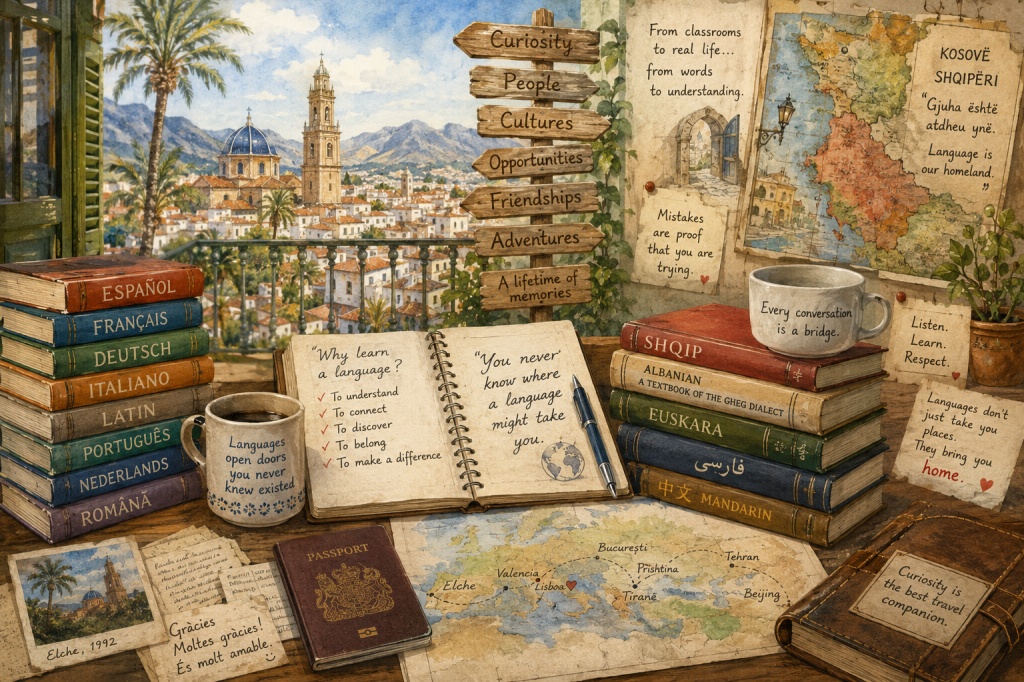
When I was choosing my GCSE options many years ago, I don’t remember thinking that languages would shape the rest of my life. I enjoyed them, certainly, but I had no grand plan involving travelling across Europe, interpreting overseas, teaching professional linguists or spending a career helping people communicate across cultures. Had someone shown me a map of the countries I would eventually visit because of languages, or introduced me to the remarkable people I would meet through them, I’d probably have smiled politely before deciding they had mistaken me for someone far more adventurous.
In truth, my language journey began much like that of thousands of other students. I was fortunate to attend a school where languages were valued, and I threw myself enthusiastically into Spanish, French, German, Italian and Latin. Each offered something different. Spanish felt warm and expressive; French possessed an elegance all of its own; German fascinated me with its wonderfully logical structure; Italian seemed almost musical, while Latin opened a window onto the history of so many European languages. Rather than competing with one another, they complemented each other beautifully, and before long I realised that every new language illuminated something about the others.
Curiosity has a habit of growing rather than diminishing, and mine certainly did. While still at school, I decided to teach myself Portuguese and eventually took exams in it alongside my other studies. Looking back, I’m not entirely sure what possessed me to add another language to an already busy timetable, except that it just seemed too interesting not to. Once you begin to notice the patterns connecting languages, the world becomes a far more intriguing place. Words become clues, place names begin to tell stories and unfamiliar signs become puzzles waiting to be solved rather than obstacles to be avoided.
By the time I reached university to study ‘Modern and Medieval Languages’, I had no intention of slowing down. Alongside the languages I already knew, I found myself studying Dutch and Romanian, discovering yet more connections across Europe. Romanian, in particular, fascinated me: a Romance language surrounded by Slavic neighbours, preserving echoes of Latin while borrowing generously from the languages around it. Dutch occupied an equally intriguing position between English and German. The more I learned, the more convinced I became that languages are among the most rewarding subjects anyone can study because they refuse to remain confined within the walls of one classroom. They spill effortlessly into history, literature, geography, politics, music, art, psychology and almost every other discipline imaginable.
The defining chapter of my university years, however, was undoubtedly my year abroad in Spain. I was based in Elche, in the province of Alicante, where I taught English at the Escuela Oficial de Idiomas as well as to private students. Like many students spending an extended period abroad for the first time, I arrived with a mixture of excitement and apprehension. It wasn’t long before I discovered that the greatest rewards rarely come from ticking famous landmarks off a sightseeing list. They come from ordinary everyday life: chatting to neighbours when hanging out washing on the roof, navigating the local market, getting your hair cut or laughing over coffee with friends who gently correct your mistakes before carrying on the conversation as though nothing had happened.
Living in the Comunitat Valenciana also taught me that immersion means far more than simply speaking the national language. I became fascinated by Valencian, the region’s own language. Nobody expected me to learn it, and there was certainly no obvious professional advantage in doing so. I was simply curious. Gradually I found myself following local television programmes (quiz shows, especially), recognising conversations in cafés and becoming part of the rhythm of everyday life around me. Speaking Spanish enabled me to communicate; learning Valencian helped me understand where I was living. It was a reminder that languages are often the key not only to countries but also to the regions, communities and identities that make them unique.
Many of my happiest memories from that year revolve around moments that could never have been recreated in a classroom. I remember celebrating my birthday on a beach in Santa Pola with friends from several countries, each of us slipping effortlessly between different languages. I remember wandering through Elche’s magnificent palm groves, visiting Valencia during its famous festivals and discovering that every journey, however short, offered another opportunity to encounter unfamiliar accents, local traditions and new ways of seeing the world. Those experiences belonged to the language just as much as they did to the place.
One of the unexpected pleasures of living abroad was sharing a flat with fellow language students from France and Germany. Our conversations drifted naturally between languages, and it became perfectly normal for someone to begin a sentence in one language and finish it in another. We compared swear words, laughed at mistranslations and occasionally discovered that words we had confidently assumed meant the same thing actually carried quite different shades of meaning. Those conversations taught me a lesson that has remained with me ever since: languages are not just different codes for expressing identical ideas. Each one reflects a particular culture and encourages us to view the world from a slightly different perspective.
If my year in Spain showed me that languages could enrich life in ways I had never anticipated, the years that followed demonstrated just how unpredictable that enrichment could become. During my teens I had developed an interest in two rather less familiar European languages: Albanian and Basque. Friends occasionally asked why I was spending my spare time learning languages that relatively few people in Britain had ever heard spoken. It was a fair question, and I’m not sure I ever had a particularly convincing answer beyond simple curiosity. There was something irresistible about discovering cultures beyond the well-trodden tourist routes and exploring languages with entirely unique stories of their own.
My work eventually took me to Kosovo and Albania, places that had previously existed for me only on maps and in books. Suddenly I found myself using Albanian every day, interpreting in situations where accuracy mattered enormously and working alongside diplomats, military personnel and local colleagues. There is a profound satisfaction in realising that years of quiet study have equipped you to help people understand one another when communication genuinely matters. Languages stop being an academic exercise and become something deeply practical and profoundly human.
Those experiences also taught me that learning a language is about far more than acquiring words. It’s about building trust. Conversations changed when people realised I had taken the time to learn their language and understand something of their culture. Doors opened that might otherwise have remained closed. Humour emerged more naturally, friendships developed more quickly and professional relationships became stronger because language demonstrated respect long before anything else had been said.
As my career developed, I found myself teaching Albanian professionally, designing courses for linguists and mentoring colleagues embarking on demanding language journeys of their own. One project remains especially memorable. There was no suitable textbook for the particular variety of Albanian that needed to be taught, so rather than lament its absence, I wrote one. It was a challenging undertaking, but also one of the most rewarding. There is a special satisfaction in creating something that enables other people to discover a language that has given you so much in return.
My professional life also introduced me to languages I could never have imagined studying when I was choosing my GCSE options. I retrained in both Farsi and Mandarin for work, discovering two entirely different linguistic worlds with histories stretching back thousands of years. Once again, I found myself reminded that every language encourages you to notice different patterns, appreciate different histories and encounter new ways of expressing ideas. Even after decades of study, the excitement of beginning a new language had lost none of its appeal.
Alongside all this, translation became another important part of my life. Over the years I have translated everything from academic certificates and legal judgments to medical questionnaires and clinical trial documentation. On the surface, these documents may appear rather ordinary, but behind every page lies a real person whose education, health, legal rights or future opportunities may depend on clear and accurate communication. Translation is often described as transferring words from one language into another, but that has never seemed an adequate description to me. At its best, it’s an act of careful consideration, thoughtful interpretation and genuine respect for another person’s words.
One of the greatest pleasures of spending a lifetime with languages is that the learning never truly ends. Even now, I continue exploring new languages just because they intrigue me. Some may never become part of my professional work, and that is perfectly all right. Not every hobby needs to become a career, and not every language needs to have an obvious commercial value. In an age when so many activities are expected to justify themselves in economic terms, there is something quietly refreshing about learning simply because the process itself is rewarding.
Perhaps that’s why I sometimes feel sad when I hear young people asking whether a language is “worth learning”. I understand the question, particularly at a time when students are encouraged to think constantly about careers and employability. Yet I suspect it begins from the wrong premise. We do not value history, music or art only because they lead directly to particular professions. We value them because they deepen our understanding of ourselves and of the world around us. Languages deserve to be viewed in exactly the same way. They are not merely vocational qualifications; they’re gateways to other cultures, other perspectives and other ways of thinking.
If I could offer one piece of advice to young people standing where I once stood, trying to decide which subjects to study, it would simply be this: allow yourself to be curious. Choose subjects that genuinely fascinate you. Don’t be discouraged if someone dismisses a language as obscure or impractical, because the world has an extraordinary habit of rewarding curiosity in ways that cannot be predicted in advance. The language that seems unusual today may become the very reason someone remembers you, offers you an opportunity or invites you into a conversation that changes the course of your life.
That’s why I continue to champion language learning whenever I have the opportunity. Languages are not relics from another age, threatened by technology or rendered unnecessary by AI or translation software. On the contrary, they matter because people matter. Every language represents a unique way of understanding the world, and every person who learns another language acquires the ability to step, however briefly, into someone else’s perspective. At a time when the world can often seem increasingly divided, that strikes me as one of the most valuable skills anyone can possess.
So, if you’re wondering whether to study a language, my advice is not based on statistics, salary surveys or employment forecasts. It’s based on experience. Say yes to curiosity. Embrace the unfamiliar. Don’t worry if your accent isn’t ‘authentic’ or if you occasionally search for the right word. Keep going anyway.
One day, perhaps many years from now, you may find yourself reflecting on a journey that has taken you much further than you ever imagined possible.
After all, that’s exactly what happened to me.


