
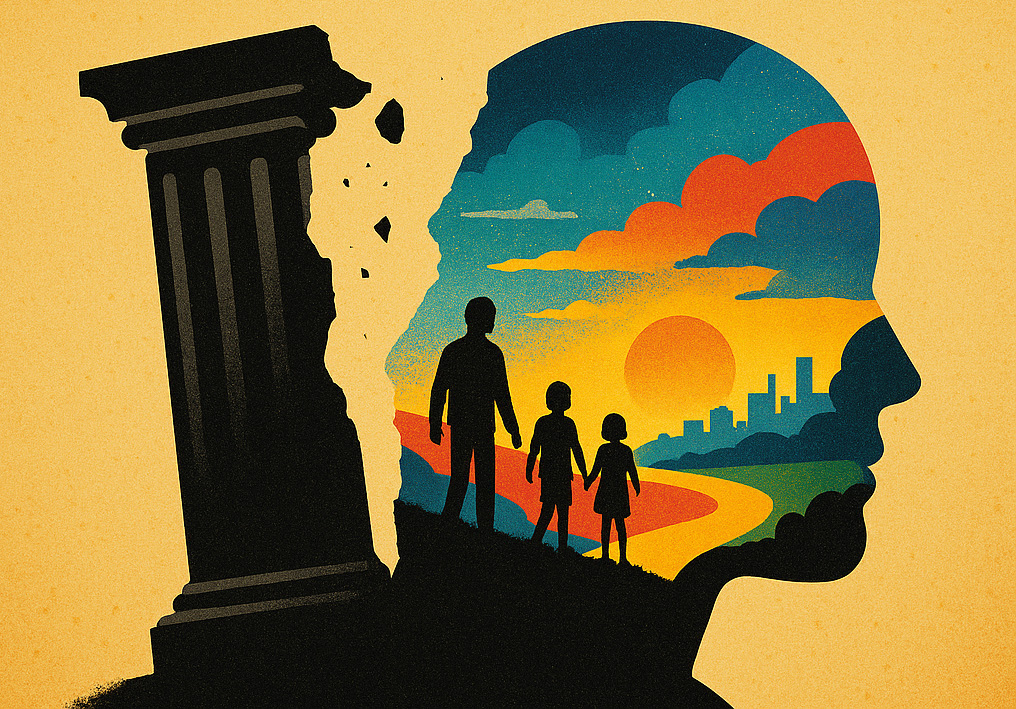
When we talk about the school subjects that shape lives, we often hear familiar names: maths, science, English. These are seen as the cornerstones – the “essentials.” But quietly, often overlooked and increasingly at risk, sits another subject. One that doesn’t just teach, but transforms. One that doesn’t just prepare students for exams, but for life.
That subject is languages.
And when language learning fades away from our schools, something much deeper fades with it. We don’t just lose vocabulary lists or classroom activities – we lose access to other people’s worlds. We lose the chance to think and feel from someone else’s perspective. We lose our ability to understand more fully. It’s not just one subject lost. It’s thousands of human stories left untold.
A Life Shaped by Languages
I was lucky. My own education was filled with the rich variety that languages offer. At school, I studied French, Spanish, German, Italian and Latin. Later, I took Portuguese at both GCSE and A Level.
Each of these languages was more than a timetable slot or a list of phrases to memorise. Each one opened a door. A window. A path to people and places I couldn’t have imagined as a child growing up in an English-speaking environment.
Through these languages, I met others not just in translation, but in their own words. I sat at dinner tables in distant towns, listened to stories shaped by different histories, danced at local festivals where the songs made perfect sense because I understood their roots. I found friendships that began not with perfect pronunciation, but with the willingness to cross the divide.
Languages didn’t just help me communicate. They helped me connect. And in connecting, they taught me to listen more deeply, observe more sensitively, and live more openly.
More Than Words: What Languages Really Teach
One of the most common misconceptions about language learning is that it’s all about words and grammar. As though it’s just a technical skill: nouns, verbs, accents and tenses. But ask anyone who’s truly spent time learning a language, and they’ll tell you the opposite.
Language learning is about people.
It’s about learning to see the world through eyes that aren’t your own. It’s about building bridges between cultures, not because we’ve read about them, but because we’ve experienced them. It’s about putting aside assumptions and embracing difference , and discovering, time and again, that difference isn’t something to fear. It’s something to value.
When we learn another language, we learn how others live. We begin to understand what they love, what they laugh at, what drives them, and how they celebrate. We learn how histories have shaped their jokes, their customs, their silences. We notice what words exist in their culture that don’t exist in ours – and that, too, is a lesson.
Languages nurture empathy. They invite curiosity. They sharpen cultural awareness and build adaptability. They help young people grow into adults who are more attuned to the nuances of a complex, interconnected world.
And perhaps most powerfully, they remind us that our way of seeing things isn’t the only way.
What We Lose When Languages Disappear
That’s why it’s so painful – and so worrying – to see language learning in decline in our schools. Each time a language course is cut, it’s not just another subject being squeezed out of the curriculum. It’s another opportunity lost. Another generation denied the chance to experience the world in its full, diverse richness.
We narrow the curriculum , but in doing so, we narrow minds. We diminish opportunities , not just for work or travel, but for personal growth. We silence voices – those of students who might have discovered a passion, and those of the communities and cultures whose languages deserve to be heard, valued and spoken.
And we begin to forget one of the most important lessons of all: that understanding someone else’s world begins with the willingness to meet them where they are – in their own language, with humility and respect.
Languages and the Bigger Picture
Of course, it’s true that language learning can lead to good grades. It can boost university applications. It can unlock exciting career paths in everything from diplomacy to international development, journalism to tourism, education to business. It can be immensely “useful” in conventional terms.
But to focus solely on those outcomes is to miss the point entirely.
Languages matter not just because of what they help us achieve, but because of who they help us become.
They make us better listeners. More sensitive travellers. More effective collaborators. More compassionate neighbours.
They help us break down barriers – not just linguistic ones, but social, emotional and psychological ones too.
They challenge the echo chamber. They reveal our blind spots. They deepen our awareness that the world is bigger, messier and more beautiful than we might have realised , and that we are part of it, not separate from it.
In a time of increasing polarisation and division, that kind of perspective is not a luxury. It’s a necessity.
A Right, Not a Luxury
The sad irony is that the benefits of language learning are often reserved for the few – for those in well-resourced schools, or those whose families can afford to travel, or those who happen to have a passionate teacher who makes the subject come alive.
But every young person deserves access to those benefits. Every student should have the chance to discover a language that speaks to them, and, through it, discover a part of themselves they never knew existed.
Removing languages from the curriculum doesn’t just reflect a short-sighted view of education. It reinforces inequality. It says, in effect, that cultural connection, international understanding, and personal transformation are optional extras – not the core of what education should be.
A Call to Champion Languages
That’s why we must keep fighting for languages in our schools. Not just in words, but in action.
We must speak up when departments are cut or teachers are not replaced.
We must support the educators who continue to light sparks in their classrooms, often against the odds.
We must challenge the narrative that languages are “too hard” or “not useful” or “only for certain students.”
And we must celebrate the enormous human potential that language learning unlocks – in every community, at every level, in every corner of the world.
My Story – and Theirs
Languages changed my life. They gave me a passport not just to other countries, but to other ways of being. They taught me that home isn’t always where you come from; sometimes, it’s where someone greets you with warmth, because you took the time to learn how.
But this isn’t just my story. It could be any student’s story. It could be the quiet child who finds their voice in another tongue. The restless teenager who sees new possibilities in the rhythm of a foreign phrase. The curious learner who suddenly understands why things are done differently elsewhere – and how that difference can be beautiful.
Every student should have the chance to write their own language story. And it begins with making sure languages stay on the page – in our classrooms, in our policies, and in our hearts and minds.
Final Thoughts
Education is about more than outcomes. It’s about expanding the imagination, building understanding, and opening doors that students didn’t even know existed.
No subject does that more powerfully than languages. So let’s stop treating them as optional. Let’s place them where they belong – at the heart of the curriculum, the community, and the conversation about what kind of world we want to create.
Because the more languages we lose, the more stories go untold.
And the more stories we share, the more human we become.

 Albaro Languages
Couldn’t agree more! Also – I think one of the most important languages teach is that it’s okay to make mistakes (and how to move on from them and build off them). After all, no language learner can learn a language without making lots of mistakes and fixing them.
LikeLiked by 1 person