What’s the best language to learn?
It’s a question people often ask me when they’re thinking about starting their language journey. They’re usually looking for something practical, something “useful”. Something strategic, global, economic. A language that might open doors in business, or boost a CV. A language that promises security, or success.
I understand the question. I really do. But my answer tends to disappoint. Because, in truth, there is no best language to learn.
Just like there’s no best culture to discover, no best people to meet, no best part of the world to fall in love with – and certainly no one perfect path to walk in life.
We like to think in rankings. In lists. In top fives and most spoken and fastest-growing economies. It makes the world feel more predictable, more ordered, somehow easier to navigate. But languages don’t sit neatly in a hierarchy. They aren’t a checklist of usefulness or global influence. They don’t follow those rules.
What they are – at their best, their truest, their most astonishing – is a way of stepping far beyond the boundaries of your own world. Whatever those boundaries might be. National. Cultural. Linguistic. Emotional.
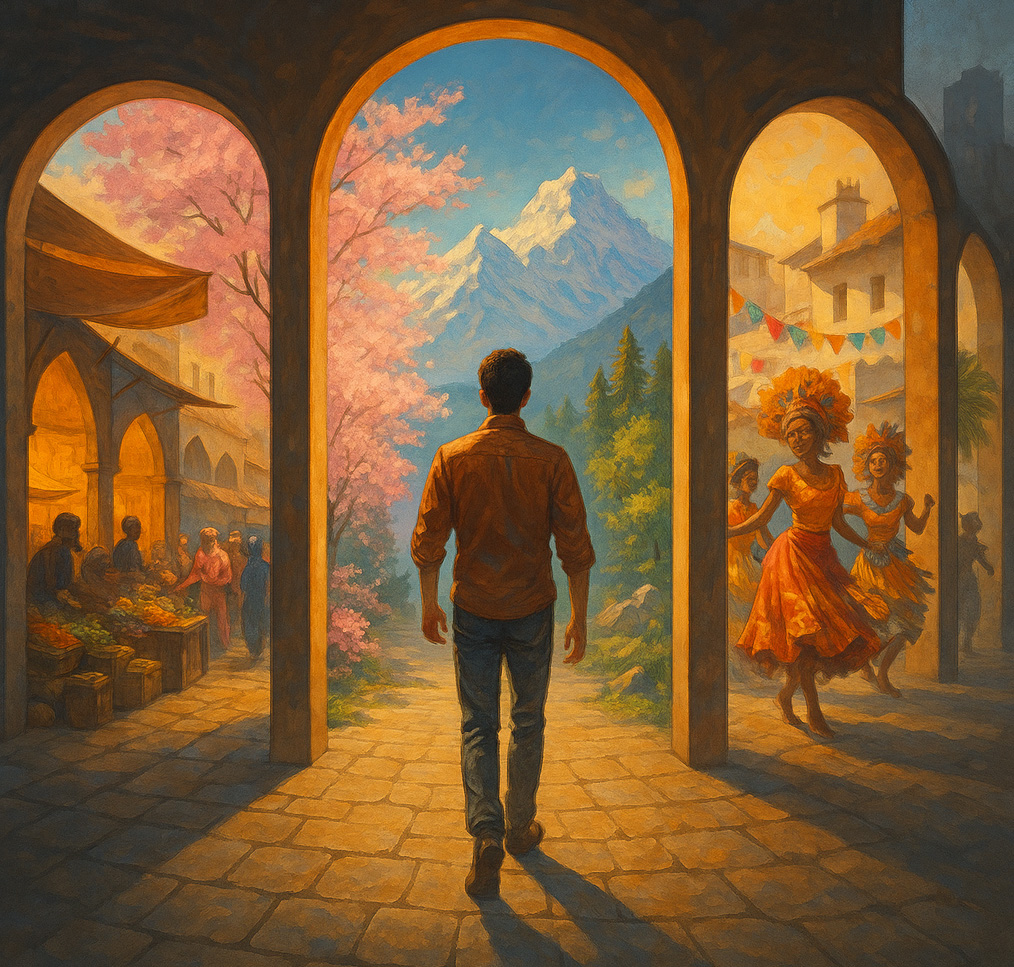
They are not ladders to climb. They are doors to walk through.
A Map That Keeps Expanding
At school, I studied the languages that were offered: Spanish, French, German, Italian, Latin. I was fascinated by the different ways people expressed ideas, shaped meaning, and reflected their cultures through language. Back then, I saw these languages as a wonderful foundation – opening doors to new experiences, perspectives and connections I was only just beginning to imagine. But life had other plans.
Over the years, my working life, travels, and sheer curiosity have led me to languages I never could have predicted back in that classroom: Albanian, Basque, Romanian, Farsi, Mandarin, and more. Each one a surprise. Each one opening a new chapter of people, places, conversations and connections. None of them part of any “grand plan” (in as much as there ever was one). None of them chosen for how many people spoke them, or how powerful those people were. I said yes to unfamiliar things. I followed the threads of curiosity.
And time after time, those choices led me somewhere I didn’t expect, but needed to go.
That’s the strange and beautiful thing about learning languages. You might think you’re adding one skill, picking up one new way to say things. But in fact, you’re being reshaped, quietly and deeply, by everything that comes with it. Every word you learn is part of someone’s world. And when you speak those words – even clumsily, even haltingly – you begin to be invited into that world, too.
You Don’t Need the “Right” Language
There’s a myth that some languages are worth more than others.
You’ll hear it all the time: “Learn Mandarin. It’s the future.” “Spanish is spoken in over 20 countries.” “Arabic will get you a job.” “French is a language of culture and diplomacy.” People argue over rankings and statistics as if learning a language were like investing in stocks and shares.
And it’s true, some languages do open more professional doors, depending on your field. But that’s not the whole picture. It’s barely even the first page of the story.
Because some of the most powerful transformations in my life have come not from the “most spoken” or “most strategic” languages, but from those I knew almost nothing about before stumbling into them.
Take Albanian. I didn’t choose to learn it because it appeared on a list of global power languages. I learned it because Albania appeared in the news in 1985, and later I had the chance to go to Kosovo – and I wanted to be able to communicate with, and genuinely understand another people. I wanted to connect. What I found there wasn’t just a fascinating language with ancient roots and incredible expressions. It was a culture, a history, a resilience, a sense of tradition I would never have known if I hadn’t taken that leap.
The truth is: you don’t need the “right” language. You just need a reason that feels right to you. A tug of curiosity. A spark of interest. A willingness to sound a little ridiculous for a while and see where it leads.
A Language Is Never Just a Language
We often think of languages in terms of grammar and rote learning. Vocabulary lists. Tenses. Exams. That’s how most of us are taught to see them.
But anyone who has really felt a language will tell you something else.
A language is a way of seeing. A way of feeling. A way of being.
It changes how you listen. It changes how you relate to others. It changes how you understand humour, or politeness, or hopes and fears. It softens you in some ways and sharpens you in others. It gives you access to a different rhythm of life.
And it does this not only when you’ve become highly competent, but especially when you’re not. When you’re still struggling to put sentences together. When you’re making mistakes and laughing about them. When someone helps you find the word you’re looking for, and the conversation continues anyway.
That moment, when someone realises you’re trying to speak their language, and they meet you halfway, that’s where the magic is. That’s the bridge being built. That’s where empathy begins.
The Most Personal Choice You Can Make
You don’t need permission to learn a language. You don’t need a strategy. You don’t need to justify it to anyone else.
Maybe you’ve always wanted to understand the lyrics of the music you love. Maybe there’s a part of your family history you want to reclaim. Maybe a book or a film or a friend sparked your curiosity. Maybe you just like the sound of it. That’s enough.
Because whether it’s Arabic or Welsh, Korean or Swahili, Polish or Portuguese, every language holds a different way of being human. A different way of expressing joy, sorrow, surprise, affection, humour, hope. Every language is a kind of home, and when you learn even a little of it, you’re saying to the people who live there: I see you. I want to understand your world.
That’s a gift.
And right now, the world needs that gift more than ever.
It’s OK Not to Know Where It’ll Take You
Some people ask: But what if I never speak like a native speaker? What if I start and give up? What if I never use it again?
To which I always say: So what?
You don’t have to finish. You don’t have to master it. You don’t have to prove anything. You just have to start.
Because what matters most isn’t the perfect grammar or the native-sounding accent. What matters is the decision to step outside your own language. To try. To be a beginner again. To show that you’re willing to reach out.
That first “hello”. That first mispronounced phrase. That first shared laugh over a mix-up. That’s the real magic.
It’s not about achieving perfection. It’s about discovering joy along the way.
A Wider World, A Wider Heart
Languages have taken me to cities I’d never expected to visit, to friendships I never saw coming, to unexpected work, unexpected questions, unexpected versions of myself. I’ve sat at tables where I couldn’t understand a word at first, and I’ve ended up singing along to songs by the end of the night.
I’ve made mistakes that became stories. I’ve had conversations that left me thinking for days. I’ve watched my own assumptions dissolve in the face of someone else’s worldview.
And none of this would have happened if I’d only stuck to what was “useful”.
So if you’re reading this and thinking, Maybe I could…, then here’s your sign. You can.
You can learn a language at any age. You can do it alongside everything else in your life. You can start small. You can change your mind. You can be imperfect. You can fall in love with a language that no one else you know is learning – and that might be the best thing about it.
A Final Thought
There’s no best language to learn.
There never has been.
There are only languages that open you up, heart, mind and soul, to lives and ideas and experiences you’d never otherwise have known. Languages that connect you with others on their terms, and help you grow beyond your own.
You don’t need a “strategic” reason to learn one.
You just need a reason that moves you. That excites you. That whispers, Try me.
So go on. Pick one. Any one. And let it take you somewhere you never expected – but will never regret.
Because when you learn a language, you’re not just collecting words. You’re collecting windows. And through each one, the world gets bigger. Brighter. More human.
And so do you.

 Albaro Languages
I completely agree! Learn whatever language you *want* to learn and enjoy the process!
LikeLike