
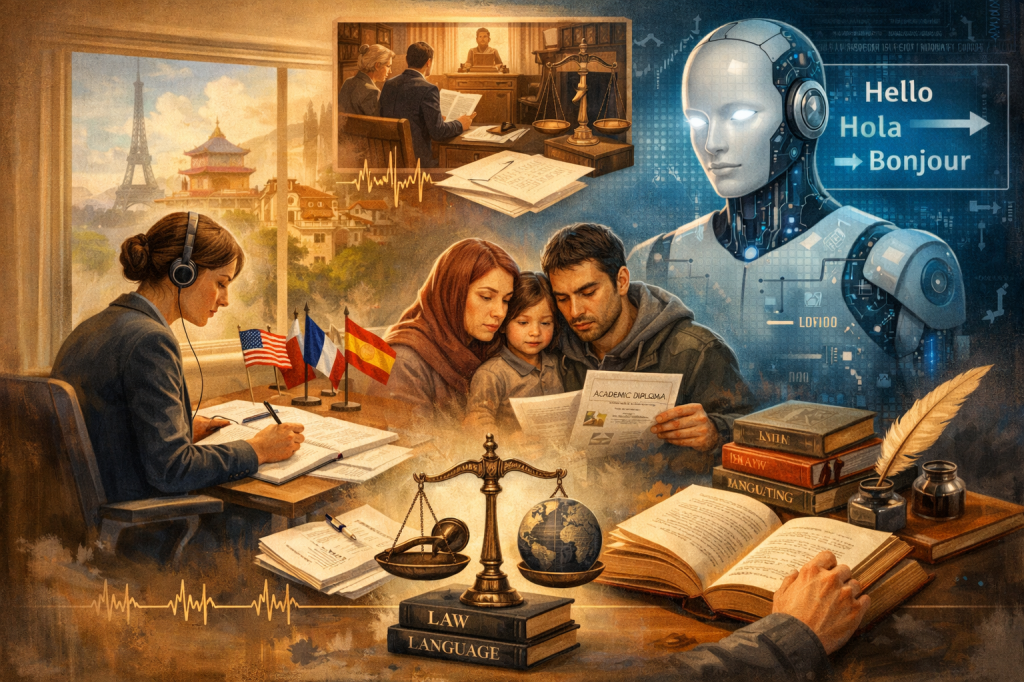
We are living in an age dazzled by velocity. Faster processing, faster outputs, faster answers. New tools appear almost every day, each promising to scale what once took time, judgement and human effort. In that climate, it is perhaps understandable that translation is sometimes framed as just another technical hurdle waiting to be automated: words in, words out, problem solved.
But that view has never aligned with my own experience of languages.
My language journey was shaped not in laboratories or on dashboards, but through living, learning and listening across borders. Through mistakes made in cafés, friendships built slowly, and moments of sudden understanding when a phrase revealed not just meaning, but mindset. Languages taught me early on that communication is never neutral. Meaning shifts with context. Tone carries weight. What is left unsaid often matters as much as what appears on the page.
That lived perspective fundamentally shapes how I understand translation. Because translation, at its best, is not a mechanical transaction. It’s a human responsibility.
Beyond Vocabulary: Translation as Understanding
Learning languages has never been about swapping vocabulary for me. It has been about stepping into other ways of thinking. About recognising that languages reflect culture, that idioms encode history, and that every language carries its own assumption about how the world works.
When you take that on board, it becomes impossible to see translation as a simple exercise in substitution.
Every text exists within a human context. It has a purpose, an audience and consequences. A sentence in an academic transcript does not function in the same way as a line in a novel. A clause in a legal document does not carry the same freedom as a marketing slogan. Translation requires not just linguistic knowledge, but situational awareness: an understanding of how a text will be read, interpreted and acted upon.
This is where the human element becomes indispensable.
Where Accuracy Is Inseparable from Responsibility
Some of the most important translations in the world are rarely read for pleasure. They are read to make decisions that shape lives.
Academic and professional certificates determine whether someone can study, practise a profession or have their qualifications recognised abroad. For migrants and refugees, these documents may be the bridge between uncertainty and stability. A mistranslated grade, title or institutional term is not a minor error; it can close doors entirely.
Legal documents carry even greater weight. Contracts, court submissions, witness statements and judgements are scrutinised line by line. A single ambiguity can alter interpretation. A misplaced modal verb can change obligation into possibility. In these settings, translation is not about speed. It’s about precision, consistency and defensibility.
Then there is literary translation, perhaps the most visible reminder that meaning is never just informational. Literature carries voice, rhythm, humour, tradition, cultural memory. Translating a literary text requires sensitivity to tone and intent, and an ability to recreate an experience rather than replicate a structure. The translator is not invisible here; they are a careful mediator between worlds.
In all these fields, translation is not a convenience. It is a responsibility.
Judgement, Ethics and the Weight of Choice
One of the least discussed aspects of professional translation is judgement.
Human translators constantly make informed decisions: when to stay close to the source and when to adapt; how to handle ambiguity; which interpretation best serves the purpose of the text. These choices are shaped by training, experience and a deep familiarity with institutional norms.
Crucially, they are also shaped by ethics.
A professional translator understands when a literal rendering may mislead. They recognise when clarity must be prioritised over stylistic elegance, or when preserving ambiguity is not only acceptable but necessary. They know when to flag uncertainty, consult a client, or refuse a task that falls outside their competence.
This ethical dimension cannot be automated.
The Role of AI: Powerful, Useful, and Limited
None of this is an argument against technology. AI has already demonstrated its capacity to assist, accelerate and support many stages of the translation process. Used thoughtfully, it can improve efficiency, help with terminology management, and serve as a valuable drafting or reference tool.
I welcome those developments.
AI can handle volume. It can identify patterns. It can process vast quantities of text at speed. In the hands of skilled professionals, it can free up time for higher-level analysis, revision and decision-making. In low-risk contexts, it can provide access where none existed before.
But assistance is not the same as accountability.
AI does not assume professional responsibility. It does not assess legal risk. It does not understand what is truly at stake for the person whose future may hinge on a document being accepted or rejected. It cannot weigh competing interpretations with academic or judicial consequences in mind.
And when precision really matters, it cannot be held accountable.
Accountability Is a Human Attribute
Accountability is perhaps the clearest dividing line between human and machine translation.
A human translator stands behind their work. They can explain their choices. They can be questioned, challenged and, if necessary, corrected. They carry professional liability and ethical obligations. Their reputation depends on accuracy, discretion and reliability.
This matters enormously in contexts such as certified translation, where documents must meet formal standards and may be relied upon by institutions, courts or regulatory bodies. The value here lies not just in linguistic accuracy, but in trust.
Trust is not something that can be automated.
Cultural Literacy and the Unspoken
Another irreplaceable aspect of human translation is cultural literacy.
Texts do not exist in a vacuum. They are shaped by conventions, expectations and shared knowledge. A human translator understands register: when language must be formal, when it can be neutral, and when it must adhere to institutional norms that may not be explicitly stated.
They recognise the unspoken conventions that govern how a document will be read and received.
They understand how politeness strategies differ across cultures, how authority is signalled, and how subtle shifts in tone can affect credibility.
These nuances are learned through immersion, experience and reflection. They are not simply data points.
Translation as Care
At its core, good translation is an act of care.
It is care for the source text and its intent. Care for the target reader and their expectations. And care for the people whose lives, work or creative expression are bound up in the words being translated.
This is especially evident when working with personal documents, testimonies or literary works. The translator becomes a steward of meaning, tasked with carrying something fragile across linguistic borders without breaking it.
Speed has its place. Efficiency matters. But care takes time.
Embracing Progress Without Losing Perspective
Technology will continue to evolve. AI tools will become more sophisticated, more fluent, more integrated into professional workflows. Resisting that reality would be neither realistic nor productive.
But embracing progress does not require us to abandon discernment.
The real question is not whether AI can translate, but where, how and under what conditions translation takes place. In low-stakes contexts, automation may be sufficient. In high-stakes environments, human expertise remains essential.
Knowing the difference is itself a human judgement.
Why This Still Matters to Me
For me, languages have always been about connection, trust and meaning. About meeting people where they are, rather than taking shortcuts past them. That philosophy naturally extends to how I view translation.
I have seen what language can unlock when it is handled with care. I have also seen how easily meaning can be distorted when context is ignored. Those experiences have taught me that translation is not just a service, but a form of responsibility.
In a world increasingly drawn to speed and scale, it is worth pausing to ask what we might lose if we forget that.
The Enduring Value of the Human Element
There are many areas of modern life where automation makes sense. Translation, in certain contexts, can benefit enormously from technological support. But there remain fields where the human element is not a luxury, but a necessity.
Where accuracy is inseparable from responsibility. Where judgement, ethics and accountability matter. Where meaning must be understood, not just generated.
In those spaces, it is still human expertise that carries the greatest weight.
And long may that remain the case.

 Albaro Languages