When people ask me why I’ve spent so much of my life learning languages, I tend to smile and say something along the lines of: “Because speaking someone else’s language opens doors that don’t even exist otherwise.”
But the truth is, it’s far more than that. It’s opened friendships, (mis)adventures, surreal roadside conversations, and unexpected life chapters I could never have planned.
Over the years, I’ve experienced the fact that learning a language isn’t just about textbooks or verb conjugations. It’s about people. It’s about the stories, laughter and connections that come from being able to step , however uncertainly at first, into someone else’s world.
And if you’re lucky, those worlds take you to some wonderfully unexpected places.
Elche: The Year I Learned More than Spanish
I spent my year abroad in Elche, near Alicante in the south east of Spain, living in an apartment with a French student and a German student. Between the three of us, we had one language in common: Spanish.
That wasn’t just a recipe for rapid learning – it was survival. None of us could order food, pay bills, get paid, or explain to the plumber why the washing machine was moving around the room without it. Within weeks, our Spanish went from slightly self-conscious exchanges to nightly debates over dinner about music, films, and occasionally, whose turn it was to clean the bathroom or fix a broken bedpost.
By day, I was teaching English in a local school – an adventure in itself. By night, we’d join the locals on warm evenings, sitting outside with cold drinks, soaking in the hum of life around us. Looking back, I didn’t just learn Spanish there. I learned that when you share a language, you share a little piece of yourself.
Portugal: Hitchhiking, Rosé and Egg-Lorry Philosophers
Fast forward a few months, and you’d find me in Trás-os-Montes, northern Portugal, travelling with a group of fellow Portuguese students. We were on a (very much) shoestring budget and a limitless appetite for adventure, which led to the inevitable conclusion: we hitchhiked.
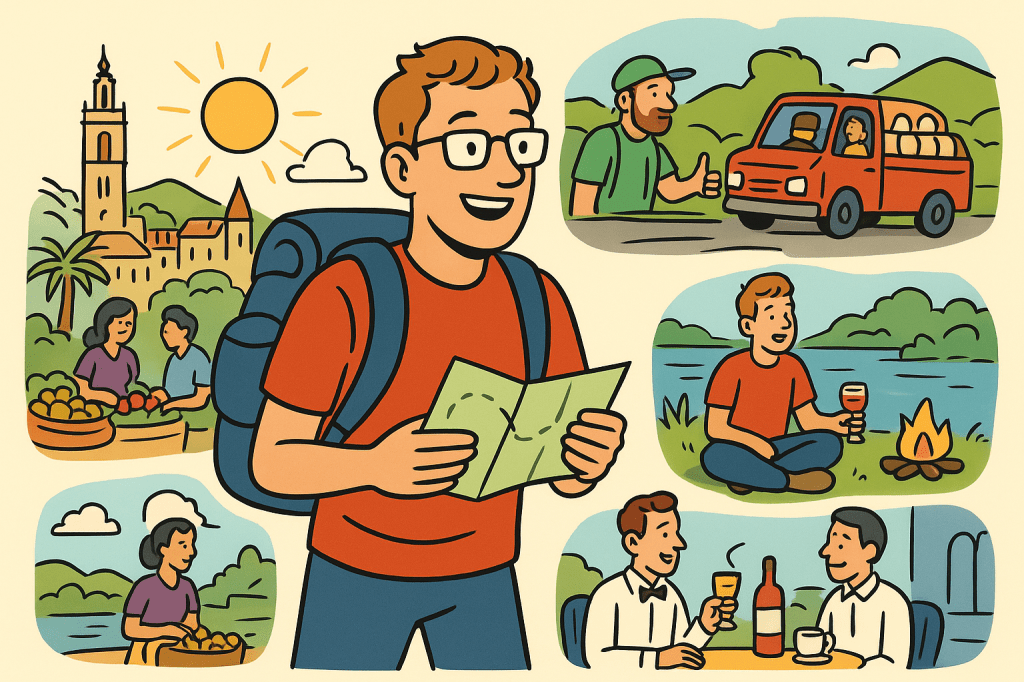
There we were, standing by the roadside, thumbs out, backpacks slung over our shoulders, when an egg-selling lorry driver pulled over. He offered us a lift, and before we knew it, we were wedged between trays of fresh eggs, chatting about life, politics, and the best way to hunt wild boar – all in Portuguese, naturally.
At one point, we camped near Bragança, right next to a lake so peaceful it felt like we’d stumbled into a postcard. With no fridge in sight, we did what any resourceful language learners would do: we cooled our cheap, but eminently valuable Portuguese rosé wine in the lake. I still swear that bottle tasted better than any Michelin-starred sommelier’s recommendation.
And on a day trip to Viana do Castelo, we wandered through a bustling open-air market, where stallholders called out in rapid-fire Portuguese, bargaining, laughing, and arguing over the price of sardines. We left with our bags full, our wallets lighter, and our Portuguese about three levels better than it had been that morning.
Belgium, Catalonia, and Málaga: Families, Food and Forgotten Words
Languages don’t just connect you with strangers; sometimes, they make you part of a family – quite literally.
I spent time living with families in Ghent in Belgium, Sabadell in Catalonia, and Málaga in Andalucía.
The Belgian family were extraordinary. They were trilingual, switching effortlessly between Flemish, French, and German – and they had a Hungarian housekeeper. Dinner conversations were like an Olympic sport in code-switching. I’d start a sentence in French, switch halfway to German, finish in Flemish, and somehow be understood. I even got to practise my very rudimentary Hungarian. It was chaos. It was beautiful. It was what languages are supposed to be.
In Sabadell, near Barcelona, I had a long, meandering chat in Catalan with the family’s elderly patriarch. He told me stories about his exploits during the Spanish Civil War; though I’ll admit, I didn’t catch every word. But that didn’t matter. Frequently, language learning isn’t about perfect comprehension; it’s about sitting there, listening, and sharing a moment you wouldn’t otherwise have had.
And then there was Málaga: long lunches under the Andalusian sun, evening strolls along the waterfront imagining the yachts I would one day never own, my first time riding a motorbike and impromptu outdoor basketball matches. And then there were the many spontaneous conversations with locals whose warmth made me feel at home instantly.
Kosovo: Becoming “One of Them”
If you’d told me years ago that I’d one day write a book teaching a dialect of Albanian, I’d have laughed. And yet, there I was, travelling around central and southern Kosovo, soaking up the different varieties of the Gheg Albanian dialect.
I didn’t just learn the language; I learned to project the accent and dialectal idiosyncrasies so well that people sometimes thought I was Kosovar. Suddenly, conversations shifted. Taxi drivers and bartenders gave me insider tips. I was invited to meet extended families. Shopkeepers smiled knowingly. And one day, sitting in a small café, someone leaned in and whispered: “You sound more like us than we do.”
That was the moment I realised something profound: speaking a language doesn’t just help you understand a place; sometimes, it makes you feel like you belong there.
Everyday Magic: Bus Stops, Markets and Smiles
Of course, not every language adventure involves egg trucks or lakeside wine. Sometimes, it’s the tiny, fleeting encounters that matter most.
As a frequent user of public transport, I’ve had impromptu chats with strangers – giving directions, swapping travel tips, or just passing the time. I’ve spoken to Castilian and Catalan-speaking Spaniards, Albanians, Croatians, Romanians, and Germans, amongst others, on trains and buses, and almost every time, the reaction is the same:
First, a flicker of surprise. Then, a smile. Because there’s something quietly magical about someone speaking your language when you’re far from home.
Teaching Languages, Spreading Passion
I’ve been lucky enough not just to learn languages but also to teach them. And there’s something deeply rewarding about passing on that passion. Over the years, I’ve taught Albanian, Basque, Romanian, Dutch, Portuguese to English speakers, and English to Spanish students.
Every lesson is an invitation: not just to cram vocabulary and grammar, but to step into another culture, to see the world through someone else’s eyes. When students catch that spark – when they laugh at their first joke in Portuguese, understand some of the lyrics of their first song in Spanish or manage their first real conversation in Basque, you can see it happen. The door opens. The adventure begins.
Neighbours, Friends and Unexpected Bonds
Languages also weave their magic closer to home. I greet my Polish neighbours (even though I only know a handful of words) and chat regularly with the Romanian family down the street after overhearing them speaking Romanian one day.
Then there was the time I struck up an impromptu conversation in Afrikaans at a bus stop with two South African neighbours. The shock on their faces was priceless, and within minutes, we were laughing together like old friends.
It never ceases to amaze me how quickly walls come down when you meet someone in their language.
Taxi Discounts and Other Perks
I’d be lying if I said there weren’t some… practical benefits, too.
Over the years, I’ve managed to get my family discounted taxi rides and the occasional cheaper meal in restaurants across France, Portugal, Albania, Spain, and even New York – simply by switching into another language. But more than saving a few euros or dollars, these moments always come with a little nod of respect, a sense of connection. When you show that you’ve made the effort to learn someone else’s words, you stop being just another tourist. You become a guest, just another human being.
Why It’s All Worth It
Learning languages has been my passport – not just to new countries, but to new friendships, new perspectives, and entire worlds I’d never have discovered otherwise.
From hitchhiking with Portuguese students and swapping jokes with Belgian families, to teaching Basque in Spain and chatting in Albanian cafés in Kosovo, every single experience has been shaped, deepened, and enriched by the willingness to step outside my linguistic comfort zone.
Has it always been easy? Absolutely not. Have I misunderstood people, mixed up words, and embarrassed myself? Frequently.
But here’s the thing: every time you stumble, you get back up. You try again. And somewhere along the way, you realise that learning languages isn’t about perfection. It’s about connection.
One Final Thought
If there’s one thing all these adventures have taught me, it’s this:
Every language you learn opens up a new version of your life you wouldn’t otherwise have had.
It might be as small as sharing a joke with a waiter in his native tongue. It might be as big as writing a book in Albanian.
But every single time, it’s worth it.
So next time you hear someone speaking another language – whether it’s on a bus, in a café, or halfway up a mountain in northern Portugal, lean in. Listen. Maybe even try a few words.
You never know where that one conversation could lead.

 Albaro Languages