For me, it’s always started with a feeling. A leap into somewhere unfamiliar. A desire not just to visit, but to understand. Not just to speak, but to connect.
It’s never been about ticking boxes, passing exams or chasing a qualification. I’ve never sat down with a textbook thinking, “This will help me climb the ladder.” That may be true for some people – and that’s completely valid. But it’s never been what drove me.
What’s pulled me in, time and again, is something much more instinctive and human: the desire to feel part of the world, not just watching it but really stepping into it. And for me, languages are how I do that.
The real value of learning a language doesn’t always show itself in grand or dramatic ways. In fact, it’s often the opposite. It arrives quietly, almost unnoticed, in small, fleeting moments that land with surprising emotional weight. Moments you don’t plan, but which stay with you long after they’ve passed.
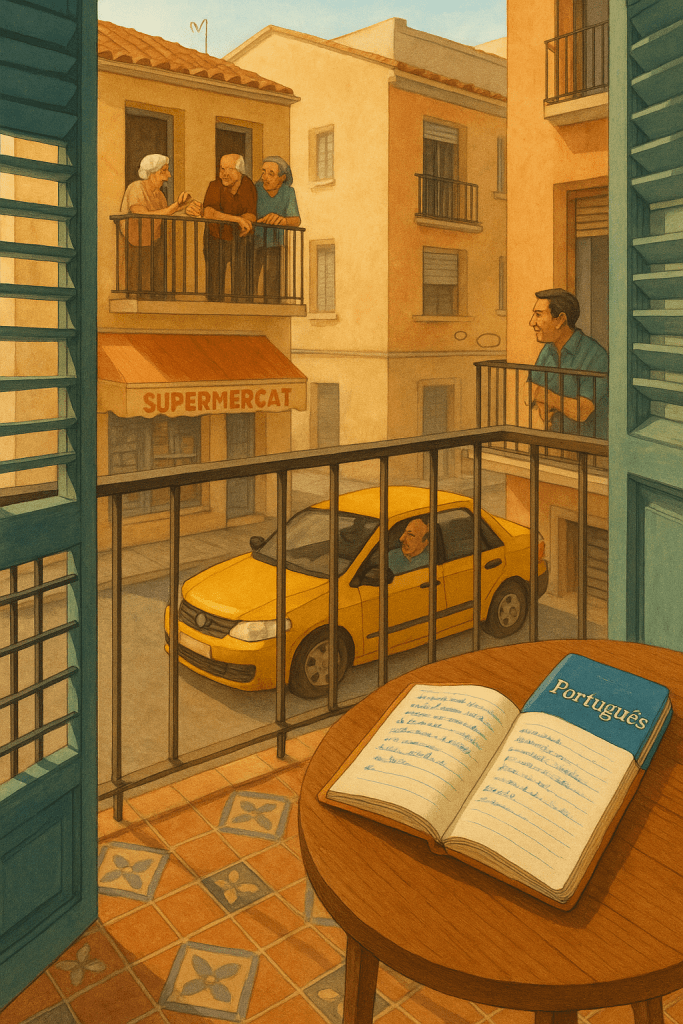
I remember one such moment in a barrio in Spain where Valencian was spoken. I was living there in what you might consider a quintessentially Spanish flat: tiled floors, narrow balcony, shutters that let in just enough morning sun to make everything feel soft and golden. What struck me wasn’t the scenery or the lifestyle, but the soundscape: the neighbours chatting across balconies, laughing, calling down to children, shouting affectionate complaints about football or the weather. And I realised I understood them.
It caught me off guard.
I wasn’t hearing foreign noise or background chatter. I was hearing people. Real people, living their lives – not performing anything for visitors. That small act of comprehension changed the quality of the moment. I felt connected in a way I couldn’t have without the language. I wasn’t observing; I was present. I wasn’t translating in my head; I was just listening.
And suddenly the ordinary felt extraordinary. Not because the scene was special, but because I was no longer outside it.
There was another time, in Croatia, when I was still new to the language and not at all confident in using it. I was in a supermarket, trying to decipher unfamiliar packaging, when a woman asked me a question. I didn’t understand all of it, but I got the gist. I replied, hesitantly, in Croatian. Her face changed immediately. She smiled – not politely, but warmly, and we had a short exchange. It was over in less than a minute, but it left a mark.
Because it could so easily not have happened. If I’d defaulted to English, or looked panicked, or shrugged and gestured, that connection would have vanished. But because I’d taken the time to learn – even just a little – I had the chance to meet her, briefly, on her terms.
That’s the gift of language. Not fluency. Not perfection. Just possibility.
There was a taxi ride in Lisbon that I still think about now. The driver was talkative, about music, politics, family, football. There was nothing special about the route we took, but the conversation gave me an insight into life in the city that I wouldn’t have got from any guidebook. We talked about fado and Benfica and government pensions. I didn’t understand every word, but I understood enough to follow. And more importantly, I wanted to follow.
What made that ride so memorable wasn’t the content, but the flow. There was no pause, no awkward switch to English, no sense that I was being indulged or simplified. It felt natural. And in that moment, I wasn’t a tourist or a visitor – I was just another person in the back of a cab, having a conversation.
Those are the moments I carry with me. They don’t come with certificates or grades. They won’t get me a promotion or appear in a portfolio. But they’ve shaped me in ways I could never have anticipated.
They’ve made me more patient, more observant. More able to sit with difference. More willing to listen before I speak.
Because when you learn another language, you’re not just learning how to conjugate verbs or pronounce unfamiliar sounds. You’re learning how to listen differently. How to shift your perspective. How to see that the way things are said – and even the way things are thought – is not universal. Every language carries a worldview. Every language has its own sense of humour, its own rhythm, its own way of holding emotion.
And when you learn a new language, you begin to absorb that. Slowly. Subtly. And it changes you.
It’s changed me.
Learning languages has helped me to see the world with more depth, more texture. It’s given me the ability to move through different spaces with a bit more grace, and with a lot more curiosity. It’s helped me feel at home in places that don’t look or sound like home at first. And it’s reminded me that most of what’s meaningful in life happens in the unplanned, the everyday, the shared moment between strangers.
And yes, sometimes people ask me: “But what’s the use? Why learn a language if everyone else speaks yours?” My honest answer? I don’t learn languages because I have to. I learn them because I get to.
Because there’s joy in it. Because it opens up the world. Because it makes travel richer, friendships deeper, and ordinary encounters unforgettable. Because it reminds me, over and over, that I am not the centre of the story – and that’s a beautiful thing to realise.
It also teaches you humility. You’re never more aware of your limitations than when you’re fumbling through a sentence in a language you’re still learning. But there’s freedom in that too. The freedom to be a learner again. To be vulnerable. To let go of control. It creates a kind of openness that’s hard to find elsewhere in adult life.
And then, slowly, you grow. You get better. The words come more easily. The conversations get longer. The pauses get shorter. Until one day you realise you’re thinking in a different language. And that realisation – that you’re not just speaking the language, but that it’s reshaped something inside you – is quietly astonishing.
Every language I’ve learned has given me new tools for understanding others. But more than that, it’s helped me understand myself.
Who I am when I speak Spanish isn’t quite the same as who I am in English. The same is true in Albanian, Romanian or Mandarin. Each language brings out something different, not in a performative way, but in a genuinely shifted mindset. It’s like stepping into a different version of myself: not better, not worse, just broadened.
And that broadening stays with you. Even when you’re back home, even when the words start to fade from memory, the perspective doesn’t. It leaves its mark.
So when people ask, “What’s the point of learning a language?” – this is what I think about first. Not exam results. Not fluency levels. Not the number of countries I can travel to. But the countless, quiet, human moments that have come my way because I chose to take a step beyond my own language. Because I chose to try.
Learning languages won’t solve every problem in the world. But it might make the world feel a little less divided. A little more reachable. A little more human.
And for me, that’s reason enough.

 Albaro Languages