
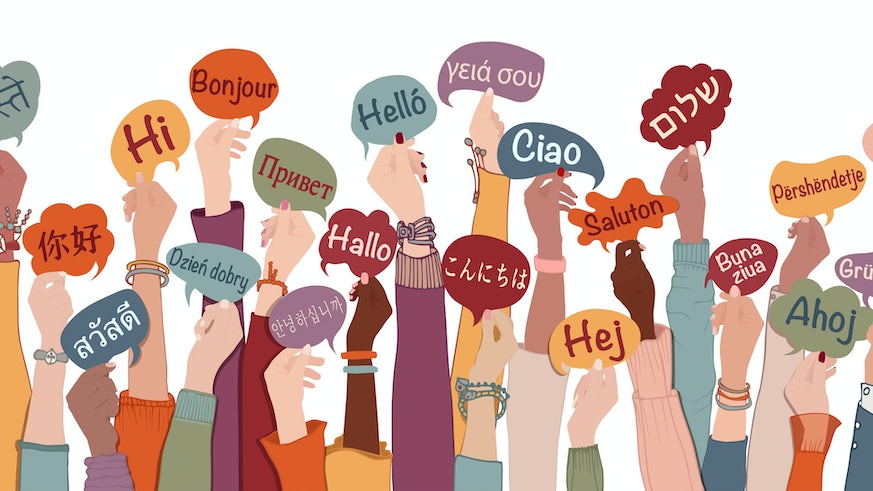
When it comes to education, languages often find themselves confined to the status of just another subject, alongside maths, science and history. However, this narrow perspective fails to recognise the profound impact language has on every facet of learning. Language is not just a standalone subject; it serves as a lens through which we perceive and understand the world around us. By delving deeper into the intricacies of language, students can enhance their comprehension and mastery of all subjects, regardless of their linguistic prowess. In this blog, I want to look at how language transcends traditional educational boundaries, adding to the educational experience for everyone.
Imagine language as a gateway to a vast and diverse landscape of knowledge. Just as a key unlocks a treasure chest, proficiency in language opens doors to a wealth of information across various disciplines. Whether you are studying literature, mathematics or sciences, language acts as the conduit through which concepts are communicated and understood. Consider mathematics, for instance. While numbers may be universal, the language used to convey mathematical concepts varies from culture to culture. Think about the vestiges of the ancient vigesimal (base-20) counting system in French (quatre-vingt-treize for ‘93’) and Albanian (njëzet and dyzet for ‘20’ and ‘40’) and its near total preservation in Basque (berrogeita hemeretzi – literally ‘two twenties and nineteen’ and laurogeita hamabi – literally ‘four twenties and twelve’ for ‘59’ and ‘92’ respectively). Then you discover Mandarin, with its entirely different counting system, including the numbers 万 and 亿, corresponding to ’10,000’ and ‘100 million’. What we consider in English to be ‘one million’ is 百万 (‘100 10,000s’) in Mandarin. And don’t even get me started on telling the time in Catalan (dos quarts de dues menys cinc – literally ‘two quarters of two minus five)…
Beyond its practical applications, the study of language – any language – confers numerous cognitive benefits. Research has shown that bilingual individuals often exhibit superior problem-solving skills, enhanced creativity and improved memory retention compared with their monolingual counterparts. The process of learning and internalising a new language stimulates brain activity, fostering neural connections that bolster cognitive function. Besides that, language learning instils valuable skills such as critical thinking, adaptability and cultural empathy, which are invaluable assets in navigating our increasingly interconnected world.
One of the most compelling arguments for the integration of language across disciplines lies in its ability to forge interdisciplinary connections. Language serves as a bridge between seemingly disparate subjects, facilitating cross-pollination of ideas and fostering a holistic understanding of the world. For instance, the study of literature not only enhances linguistic proficiency but also provides insights into historical contexts, societal norms and cultural values. Similarly, scientific inquiry often requires effective communication of complex ideas, a skill honed through the mastery of language. By transcending disciplinary boundaries, language enhances the educational experience by encouraging students to approach learning from a multidimensional perspective.
Contrary to popular belief, language proficiency extends far beyond academic pursuits; it has tangible real-world applications. In an increasingly globalised society, multilingualism has become a valuable asset in both personal and professional spheres. Whether travelling abroad, engaging in international business ventures or building cross-cultural relationships, proficiency in multiple languages opens doors to a myriad of opportunities. Plus, language skills are in high demand across a wide range of industries, from diplomacy and translation to tourism and technology. By investing in language education, individuals equip themselves with a versatile skill set that transcends geographical and cultural boundaries.
Language serves as a vehicle for inclusivity and diversity, allowing individuals from diverse linguistic backgrounds to share and show empathy for their unique perspectives and experiences. By embracing multilingualism in educational settings, institutions promote cultural exchange and celebrate linguistic diversity. What’s more, language learning encourages empathy and understanding, breaking down barriers and fostering a sense of global citizenship. In an increasingly interconnected world, proficiency in multiple languages promotes mutual respect and appreciation for different cultures, laying the foundation for greater acceptance and inclusion.
Languages are not just another subject at school, when you consider that language is the cornerstone of education itself. By viewing every subject through the lens of language, students gain a deeper understanding of the interconnectedness of knowledge and human thought and develop essential skills that go beyond disciplinary boundaries. Whether exploring the intricacies of mathematics, unravelling the mysteries of science or seeing society reflected through literature, language serves as both a tool and a treasure, enriching the educational and all-round life experience for everyone. In today’s rapidly evolving, interconnected yet diverse world, proficiency in language is not a luxury reserved for linguists alone but a necessity for success in all aspects of life.

 Albaro Languages