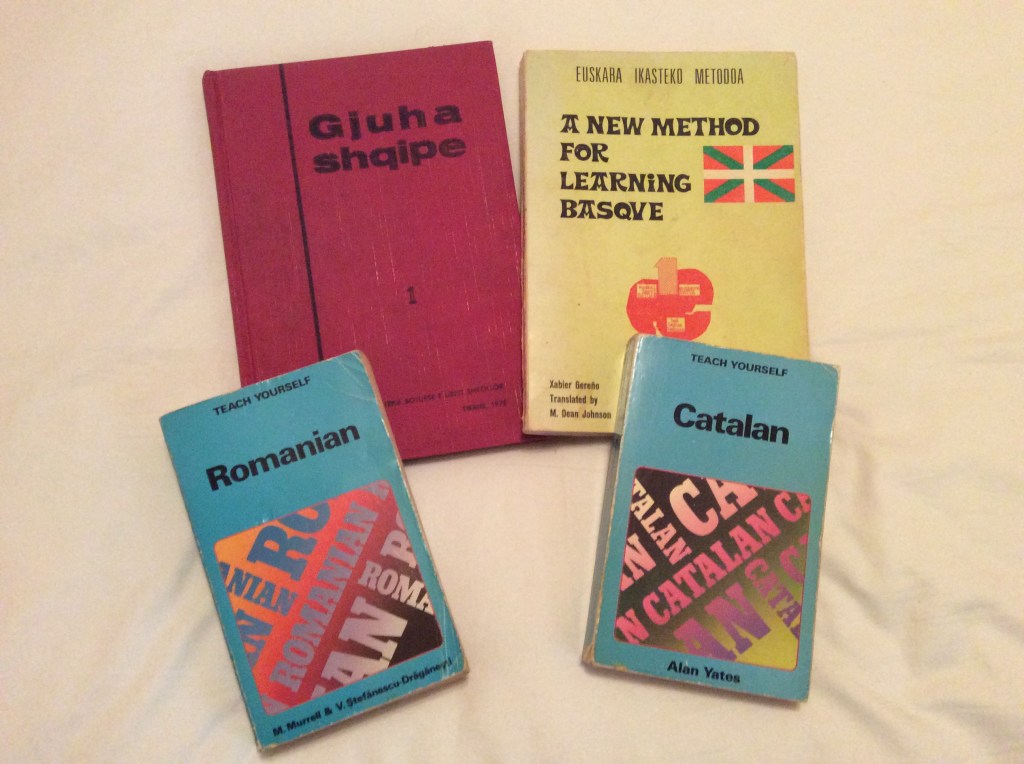
For me, discovering languages like Albanian, Basque, Romanian and Catalan has been an enriching journey that goes way beyond linguistic proficiency alone. These languages, considered by many to be ‘niche’, have been my gateway to a myriad of career opportunities and unexpected experiences, and they could do the same for you.
Learning Albanian, for instance, has not only taken me to Kosovo and Albania on many varied and somewhat unparalleled interpreting assignments, but has also led to teaching in different environments, dialect studies, a regular column in a Kosovo newspaper at one point and becoming a published author. Of course, it’s also given me deeper insights into a unique and fascinating culture and people. It opened doors to projects and collaborations I wouldn’t have anticipated, showcasing the professional advantages of adding a less commonly taught language (or two) to your language portfolio.
Basque, with its air of mystery and ‘otherness’, origins and sister languages lost in the mists of time and fiendishly fun grammar that confounded the Devil (allegedly), not only let me access even more of the Iberian Peninsula, but also gave me a real connection with a tight-knit community, rightly proud of their distinct heritage. This connection has facilitated networking and partnerships, demonstrating how language proficiency teamed with niche cultural awareness can foster professional relationships in unexpected ways.
Romanian, an often (unfairly) overlooked Romance language with a rich history, literature and intriguing mix of French, Italian, Turkish and Slavic influences, provides me with a nuanced understanding of a very different market and cultural landscape. Thanks to Romanian, I’ve taught diplomats and civil servants, set and marked many an exam and was once the first to inform a rather shocked Moldovan lady that she was expecting her first child. Romanian has proven invaluable in terms of translation, interpreting and teaching opportunities alike, underscoring the practical benefits of language diversity.
Catalan, another overlooked and exciting Romance language with its own rich traditions and identity, all started for me with a single old Catalan newspaper in my school library. I loved the melting pot of French, Spanish and Occitan. So it was no surprise that, on my first Spanish exchange to Sabadell, near Barcelona, I endeared myself even more to my host family by insisting that we spoke Catalan and watched Catalan TV! We ate botifarra and pa amb tomàquet and Catalan became a catalyst for cultural immersion. It gives me a way-in to Catalan culture that Spanish alone cannot provide.
Beyond the specific advantages tied to each language, the cumulative effect of learning diverse languages has (I hope) significantly sharpened my cognitive abilities and enhanced cultural awareness and interpersonal relationships. It’s not just about mastering words; it’s about developing a multifaceted skill set that extends to problem-solving, critical thinking, adaptability, cross-cultural communication and much, much more.
In essence, learning languages is a transformative experience that extends far beyond communication. It’s a lens through which you gain insights into different cultures, navigate complex professional landscapes and develop a versatility that enhances every facet of your skill set. Embrace the journey and let languages become your passport to a world of unforeseen possibilities.

 Albaro Languages