
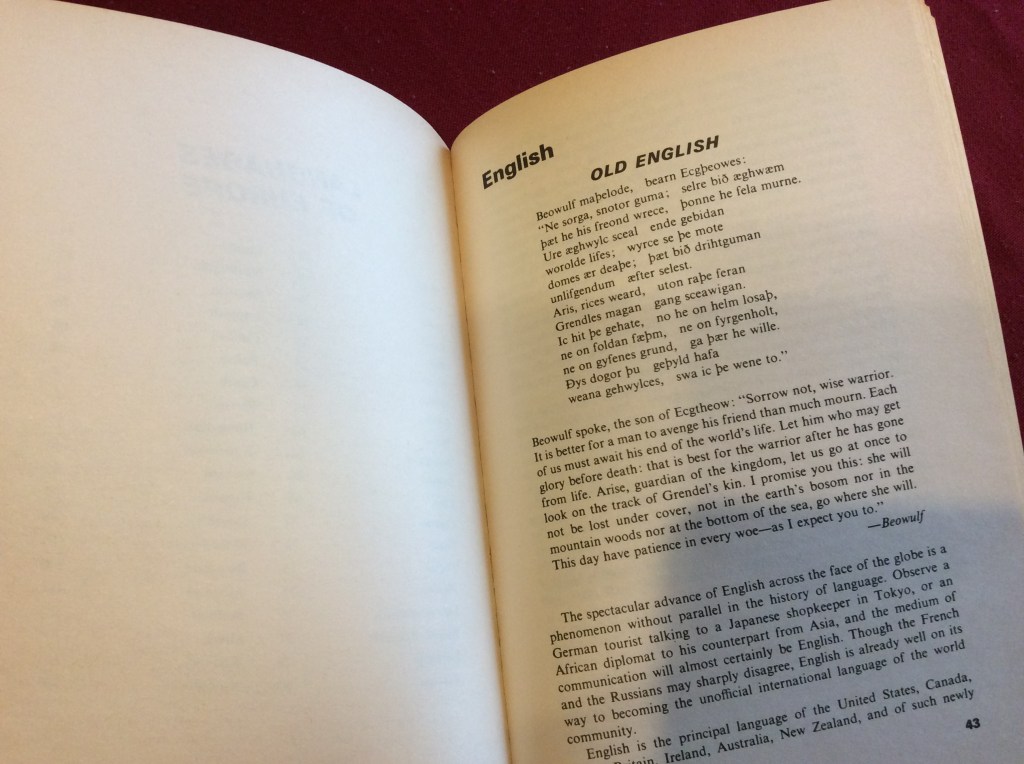
Language is a dynamic, ever-evolving entity, and the study of its origins can be a fascinating journey into the past. One such linguistic time machine is Old English, also known as Anglo-Saxon. Have you ever wondered why more than one goose are geese, why there’s one child, but two children and why I swim today, swam yesterday and would have swum the Channel? Well, delving into the rich history of Anglo-Saxon offers insights into the development of modern English, a gateway to understanding other Germanic languages, a window into the evolution of grammar rules and relevance in various modern fields of work and study. In this blog, I will explore the reasons why embarking on a study of Old English is well worth considering.
Old English, the earliest form of the English language, was spoken from around the mid-5th century to around the late 11th century. It was a Germanic language that, through the centuries, underwent various transformations and influences, ultimately giving birth to the Modern English we use today. To understand this evolution, let’s examine a few examples:
Old English provides the roots for many words in Modern English. For instance, “stān”, “hwæt”, “mæġden”, “gōd morgen”, “swīn”, “hund” and “bēam” in Old English evolved into “stone”, “what”, “maiden” (“girl” in Old English – think of Mädchen in German), “good morning”, “swine” (or just “pig”), “hound” (or “dog”) and “beam” (although it originally meant “tree”) in Modern English.
Old English had complex inflectional grammar, including cases for nouns, grammatical gender and verb conjugations, rather like modern German (but even more of them). These features simplified over time into the more straightforward grammar rules of modern English. For example, Old English had distinct definite articles for gender, number and case, such as “sē” for masculine nouns, “sēo” for feminine nouns and “þæt” for neuter nouns, which eventually evolved into modern “the.” Talking of neuter nouns, “the girl” in Old English was “þæt mæġden” – a neuter noun, just like “das Mädchen” in German today. Even more bizarrely, “wīfmann”, meaning “woman”, was a masculine noun, as “sē mann” (“the man”) was masculine.
Studying Old English provides a unique opportunity to explore the linguistic connections between English and other Germanic languages. It serves as an excellent introduction to understanding the building blocks of languages like German, Dutch and Swedish. For one thing, Old English shares many cognates with other Germanic languages. For example, the Old English word “hund” (dog) is strikingly similar to the German “Hund” and Dutch “hond”, “cyning” (king) resembles Dutch “koning” and we’ve already seen “mæġden” (girl), “morgen” (morning) and “bēam” (tree) – think of “Baum” and “boom” in German and Dutch.
Old English and its Germanic counterparts exhibit similarities in their grammatical structures. Understanding Old English cases, gender and verb conjugations can make it easier to grasp similar features in German, Dutch or the Scandinavian languages. These languages all have common origins, stemming from Proto-Germanic. By studying Old English, you gain insights into the ancestral language, making it easier to trace the family tree of the Germanic languages and perhaps branch out into Old Norse, Old Low Franconian or even Icelandic, which, unlike English, has remained tantalisingly true to its “old” form, keeping the runic letters (ð, þ and æ) that English has long since lost, for example.
Old English is a treasure trove for language learners and enthusiasts, sociologists and historians alike. Its complex grammar offers a valuable and fascinating opportunity to explore linguistic principles and the historical context behind language development. These intricate grammar rules, including noun declensions, verb conjugations and clearly codified parts of speech, encourage a deeper understanding of grammatical terminology in modern languages, as well as linguistic structures generally and how they have evolved over time.
Studying Old English helps to uncover the historical changes and influences that have shaped the English language and the lives of those who were the first to speak it. It allows you to trace the language’s journey from its early Germanic roots to its modern form, while simultaneously bearing witness to historical changes, developments in society and technological advancement. Old English also acts as a bridge for comparative linguistics, allowing researchers to trace linguistic evolution across various related languages. It provides valuable insights into the broader field of language science.
But the study of Old English is not just a historical pursuit. It also has practical, modern-day applications across a range of fields:
For literature enthusiasts and scholars, Old English opens doors to the rich literary heritage of Beowulf, the epic poem that remains a foundational text in English literature, the Anglo-Saxon Chronicle, an invaluable, first-hand source of reference for historians studying the Anglo-Saxon period and the Exeter Book, a vast collection of sophisticated poems, verses and riddles.
Understanding Old English can genuinely unlock historical texts, artifacts and the culture of the Anglo-Saxon period. Old English can be a valuable asset for linguists and language teachers, as it offers a historical context for language evolution and helps teach linguistic structures and embed grammar rules. Translators can apply a knowledge of Old English to deciphering historical documents or perhaps translating as yet undiscovered (or untranslated) literary works. What’s more, the study of Old English can open doors to academic research and provide opportunities in linguistics, philology, history, anthropology, social change and literature.
So in summary, delving into the world of Old English is not only a fascinating exploration of the past but also a practical and enlightening journey into the intricacies of language. From understanding the roots of modern English to discovering the connections with other Germanic languages, the study of Old English offers a unique and enriching experience. Whether you’re a language enthusiast, a history buff, or a scholar looking to expand your horizons, Old English is a treasure trove of knowledge waiting to be unlocked. So, why not embark on this linguistic adventure and let Old English lead you through a maze of time and language?

 Albaro Languages
One Reply to “Discovering Old English: A Language Time Machine”