
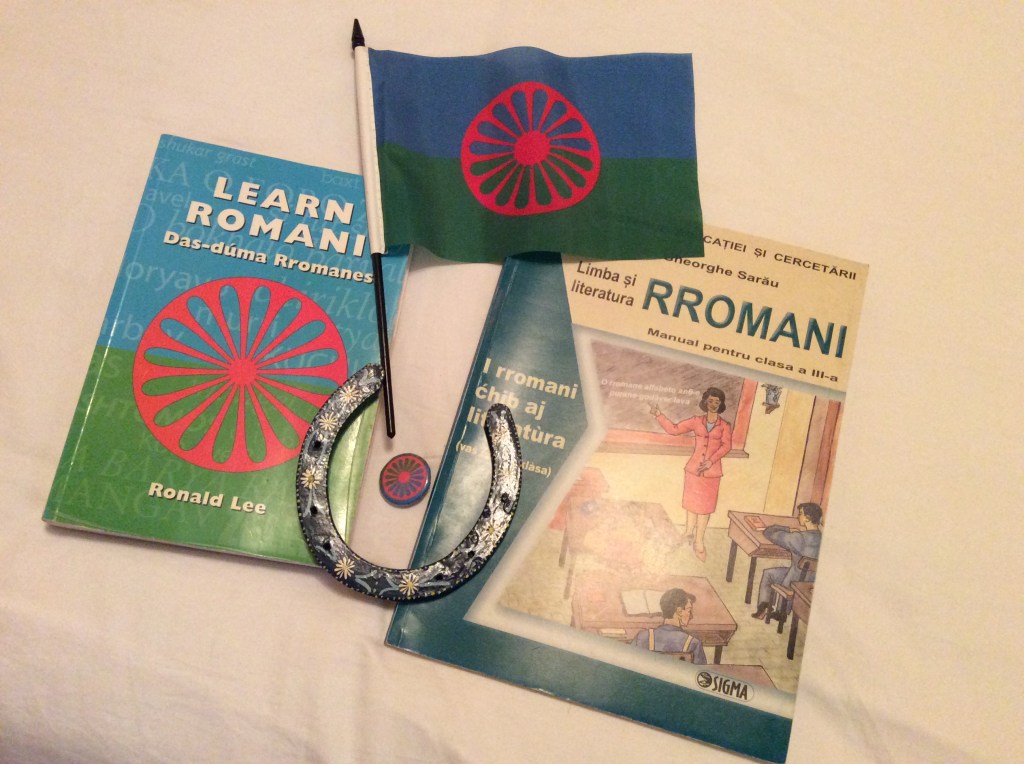
When I discovered Romani heritage in my family tree, naturally I had to learn the language. What I didn’t realise then was how rich, expressive and complex the Romani language was. Not only that, but the Romani language is shrouded in mystery. It’s a fascinating linguistic journey into a world steeped in history, traditions, and lifestyles that span across continents. It is a language that reflects the resilience and cultural richness of the Romani people. In this exploration, I want to delve into the Romani language, uncovering its origins, influences, and unique features and discovering how Romani words have found their way into the English language. Prepare for a linguistic revelation.
The Romani language, also known as ‘romani čhib’, is the language of the Romani people, a diverse ethnic group with roots in modern-day India. The word ‘romani’ is not actually a noun; it’s an adjective with a feminine case ending, as the word ‘čhib’, meaning ‘language’ is feminine in Romani. The Romani diaspora, which began over a thousand years ago, has spread their language across Europe, the Americas, and other parts of the world. Learning Romani provides an invaluable gateway to understanding this remarkable journey.
One of the most intriguing aspects of the Romani language is its rich history. Romani is an Indo-Aryan language, and its origins can be traced back to the languages spoken in the Indian subcontinent. As Romani people migrated westward, their language absorbed elements from the regions they traversed. This linguistic evolution gives Romani a unique character, as it carries traces of Greek, Armenian, and Persian, among other influences – e.g. ‘zervo’ and ‘drom’ (‘left’ and ‘road’) from Greek, ‘grast’ and ‘ćikat’ (‘horse’ and ‘forehead’) from Armenian, ‘ambrol’ and ‘zumav-‘ (‘pear’ and ‘try’) from Persian.
Romani is not merely a means of communication; it’s an art form. This language is inherently expressive, allowing speakers to convey emotions, stories, and experiences with great depth and nuance. Its expressive power lies in its vocabulary and grammar, both of which are rich and multifaceted. Contrary to popular opinion, Romani is not a ‘secret code’, jargon or ‘made-up language’. Its basic vocabulary is shared with its Indian sister languages (‘thud’, ‘manro’, guruv’, ‘pani’, ‘pučh-’, meaning ‘milk’, ‘bread’, ‘cow’, ‘water’, ‘ask’), its cardinal numbers are an intriguing mix of Sanskrit-based and Greek-based: ‘jekh, duj, trin, štar, panž’ for numbers one to five and ‘efta, oxto, inja’ for seven to nine.
Romani grammar is a veritable joy for an unapologetic linguaphile like me! It has two grammatical genders (masculine and feminine), a definite article that agrees with gender, number and sometimes case, eight cases for nouns, including a bizarre ‘ablative’ ending that can be added to verbs – ‘našlo’ means ‘he ran’, but add an ablative ending and you get ‘našlotar’ – ‘he ran away’! Romani has several verb conjugations, multiple tenses and moods, active/passive conjugations that are reminiscent of those in Albanian and it’s a member of the so-called Balkan Sprachbund, which, in basic terms, means that it can form its future tense using a modified form of the verb ‘want’, it does not have a distinct ‘infinitive’ form of the verb, instead using subjunctive phrases and it uses replicated ‘clitic’ pronouns. For example, ‘kam phenav tuke o ćaćipe’ (‘I will tell you the truth’), in which the future marker ‘kam’ is a shortened form of the verb ‘kamel’ (‘want’). ‘Le romane žene šaj te xakjaren but čhibja’ (‘the Romani people can understand many languages’), where ‘te xakjaren’ is a subjunctive form, and ‘o lil kaj xramosardem les’ (‘the letter that I wrote’), where ‘les’, meaning ‘it’ is replicating the word ‘lil’.
Central to Romani culture is the tradition of oral storytelling, poetry and song. Romani communities have a rich heritage of passing down stories, folklore, and history through spoken word and music, all the more so, because Romani was never a written language and, despite many proposals and attempts, still does not have one universally accepted written form. Only through learning the Romani language can you gain privileged and inimitable access to this vibrant tradition, enabling non-Romani people (known as ‘gadže’) to connect with the essence of Romani identity. The first poem that I ever learned in Romani is still my favourite today:

Interestingly, the influence of the Romani language has extended beyond its community and into the English language. Over the centuries, Romani words have integrated into English, enriching its lexicon. Perhaps the most common examples are: ‘pal’, which derives from the Romani word ‘phral’, meaning ‘brother’, ‘lollipop’, which actually stems from the Romani ‘loli phabaj’, meaning ‘red apple’ (again, an adjective with feminine agreement, as apple is feminine in Romani) and ‘chav’, which simply derives from the Romani word ‘ćhavo’, meaning a ‘(Roma) boy’ (as an aside, a non-Roma boy is not a ‘ćhavo’, but a ‘raklo’). More obscure or regional examples are ‘mush’ and ‘wonga’, slang terms for ‘man’ and ‘money’, which have their origins in Romani ‘murš’ (‘man’) and ‘vangar’ (‘coal’, as coal was once used as a currency when trading with Romani people).
In conclusion, the Romani language is a treasure trove of history, traditions, and unique expressions. Its Indo-Aryan roots, influences from various languages, and expressive power make it a language worth exploring. What’s more, its connection to oral storytelling and song deepens our understanding of Romani culture. For those with or without a background in languages, learning Romani can be a fascinating linguistic adventure. Finally, the presence of Romani-origin words in English underlines the enduring impact of this language on the wider world. So, whether you’re drawn to its history or captivated by its expressive beauty, learning Romani promises a journey into a world brimming with culture and meaning. Te aven savorre sasteveste, baxtale! – May you all have good health and happiness!

 Albaro Languages